

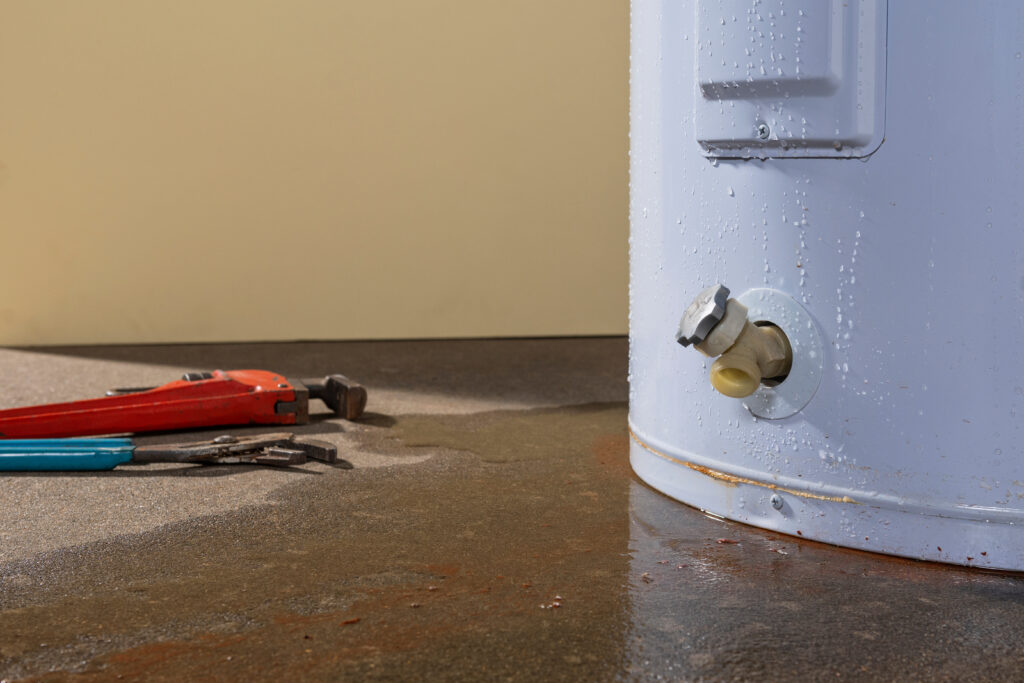
Quick Answer for Homeowners Searching “water heater leaking kenosha”
Water heater leaking Kenosha? Here is how to decide if you should repair or replace a bottom leak, what it might cost, and how fast it can be fixed. If you need help now, call Watertight Plumbing for fast, reliable service in Kenosha County and Lake County. We are available 24 hours a day.
First Things First: Make It Safe and Stop the Water
If you see water pooling under your water heater, act quickly. Leaks can worsen without warning and can lead to water damage, mold, or electrical hazards. Before you diagnose the problem, make the area safe.
- Turn off power: For electric heaters, shut off the breaker labeled Water Heater at the panel. For gas heaters, turn the gas control valve to Off or Pilot and avoid any open flames.
- Shut the cold water supply: Turn the cold supply valve on top of the unit clockwise to stop flow. If the valve is stuck or damaged, you can shut the main water valve to the house.
- Protect the area: Move valuables away. Use towels or a wet vac to pick up standing water. If water reached outlets or appliances, do not touch them and call a professional.
- Relieve pressure if needed: If the tank is making boiling or hissing sounds, carefully open a hot water faucet at a sink to relieve pressure. Use caution because water can be very hot.
- Call a professional: If you are unsure about any step or you smell gas, call Watertight Plumbing immediately for 24/7 emergency service.
Why Water Heaters Leak From the Bottom
Several parts of a water heater can cause a bottom leak. Some are minor and quick to fix. Others signal that the tank has failed and must be replaced. Here are the most common reasons:
- Drain valve seepage: The drain valve near the base may be loose, cracked, or stuck partially open. This is a common source of slow puddles.
- Temperature and pressure relief line discharge: The T and P valve is often on the side or top, but its discharge tube runs down the side. If the valve releases water, it exits at the bottom and looks like a base leak.
- Rusted tank from internal corrosion: If the glass lining inside the tank fails, water corrodes the steel shell. When the shell rusts through, water leaks out at the bottom. This is not repairable and needs a full replacement.
- Condensation and cold floor contact: In cool basements, cold water entering a hot tank can cause condensation that drips down. This can look like a leak but often dries once demand decreases.
- Leaking cold or hot connections above: A connection or valve above can drip and run down the tank jacket, pooling at the bottom. It may seem like a bottom leak even though the source is higher.
- Failed gasket or element on electric models: Electric heaters have heating elements sealed by gaskets. If a gasket fails, water can trickle down and collect below the tank.
- Expansion issues: Without a working expansion tank on closed systems, thermal expansion can force the T and P valve to open. That water exits near the bottom through the discharge tube.
- Pan overflow: If your heater sits in a pan, the pan can overflow when there is a large leak or clogged pan drain. Pan leaks often appear around the base.
How to Pinpoint the Leak Source
Finding the exact source will tell you if repair or replacement is the smart move. Use this simple process:
- Dry the tank and floor: Wipe the outside of the tank, fittings, and nearby piping so you can see new water.
- Inspect the drain valve: Look for drips at the spout or threads. Tighten gently by hand or with a small wrench. Do not overtighten.
- Check the T and P valve discharge tube: If water is dripping or cycling from the tube, you may have overheating, high pressure, or a failing valve.
- Look at top connections: Dry the hot and cold water connections and watch for seepage that runs down the jacket.
- Examine element gaskets on electric units: Look for moisture around the element covers.
- Watch for weeping at the tank seam: Water creeping from the tank seam or the bottom plate usually means internal tank failure.
- Run a short test: Turn water back on for a few minutes. If you can safely power it, run one hot water faucet. Watch for new drips.
- If unsure, call Watertight Plumbing: Our licensed techs use professional testing to find hidden leaks fast.
Repair or Replace? Your Kenosha Decision Guide
The right choice depends on the age and condition of your unit, the leak source, and your budget. Use these guidelines for a water heater leaking Kenosha homeowners can trust.
Repair Makes Sense When
- The drain valve is leaking and the tank is otherwise healthy. Replacing the drain valve is a straightforward fix.
- The T and P valve is faulty, but the tank does not overheat or build pressure. A new T and P valve and a check of system pressure can solve the issue.
- A top connection or flex line is dripping. Resealing the fitting or replacing the line is cost effective.
- An electric element gasket is seeping. Replacing the gasket and element if needed can stop the leak.
- The water heater is under 8 years old, shows no rust, and is properly sized for your home.
Replace Makes Sense When
- You see rust or water weeping from the tank body or seam. Internal tank failure is not repairable.
- The heater is 10 to 12 years old or older. At this age, replacing often costs less over time than repeated repairs.
- There is heavy sediment buildup due to hard water common in southeastern Wisconsin and Lake County. Sediment accelerates wear and can cause overheating and leaks.
- You need frequent T and P discharge to relieve pressure. This may indicate bigger system issues, and replacement with upgrades like an expansion tank can protect your home.
- You want higher efficiency, faster recovery, or endless hot water. Replacement is the moment to upgrade to a high efficiency tank or a tankless unit.
Typical Costs and Timelines in Kenosha County
Every home is different, but these ballpark ranges reflect common pricing in the Kenosha area. Exact costs depend on brand, capacity, venting, code upgrades, and site conditions. Ask Watertight Plumbing for a firm, written estimate.
- Drain valve replacement: Often 125 to 350 dollars depending on access and valve type.
- T and P valve replacement and testing: Often 150 to 350 dollars.
- Top connection or flex line repair: Often 120 to 300 dollars.
- Electric element and gasket replacement: Often 180 to 400 dollars.
- Standard tank replacement 40 to 50 gallons gas or electric: Often 1,100 to 1,900 dollars installed, including haul away and basic code items.
- High efficiency or power vent tank replacement: Often 1,700 to 2,800 dollars installed.
- Tankless water heater replacement or conversion: Often 2,800 to 5,200 dollars installed depending on gas line, venting, and condensate requirements.
Timelines
- Emergency shutoff and leak control: Often within 60 to 90 minutes for local calls.
- Same day repairs: Many minor repairs completed in 1 to 3 hours.
- Standard tank replacement: Typically 2 to 5 hours on the same day.
- Tankless replacement or conversion: Often completed in one working day.
Gas vs Electric vs Tankless: What to Consider
Gas Water Heaters
Gas units heat fast and often cost less to run than electric in our region. If your gas tank is leaking at the bottom and is over 10 years old, replacement is usually the smart move. When replacing, consider a power vent or higher efficiency model if your venting and layout support it.
Electric Water Heaters
Electric tanks are simple and reliable. If a bottom leak is from an element gasket, a repair may be all you need. If the tank body is compromised, replace rather than repair. Upgrading to a larger tank can reduce shortages for growing families.
Tankless Water Heaters
Tankless systems provide hot water on demand and can reduce energy use. They do not hold a large tank of water, so tank leaks are not a concern. If your old tank has failed, this is a good time to explore tankless. Watertight Plumbing installs and services leading brands and will size the system for your home’s fixtures and winters in Kenosha County.
Prevent Future Leaks and Extend Water Heater Life
Regular care can add years to your water heater and prevent surprise leaks. Here is a simple maintenance plan:
- Flush sediment each year: Sediment collects at the bottom and causes overheating and tank damage. Annual flushing helps in hard water areas.
- Check the anode rod every 2 to 3 years: The anode rod protects the tank from corrosion. Replace it before it is fully consumed.
- Test the T and P valve annually: Lift the test lever briefly to confirm it opens and reseats. If it drips or sticks, replace it.
- Inspect connections and valves: Look for white crust, rust stains, or damp insulation. Early fixes cost less.
- Add or service the expansion tank: A working expansion tank reduces pressure spikes and protects the water heater and plumbing.
- Install a drain pan and leak alarm: A pan with a drain or alarm can prevent water damage by catching small leaks early.
- Schedule professional maintenance: A yearly check by Watertight Plumbing catches issues before they become emergencies.
Why Kenosha Homeowners Trust Watertight Plumbing
Watertight Plumbing is your local, family-owned plumber with more than 30 years of experience. Our licensed, bonded, and insured team provides 24/7 emergency service for both homes and businesses. Whether the job is a simple drain valve swap or a full water heater replacement, you get fast, courteous service and work that meets local codes.
- Emergency Plumbing: Fast response for water heater failures, burst pipes, gas leaks, and sewer backups.
- Plumbing Installation and Repair: Water lines, fixtures, toilets, garbage disposals, and sump pumps.
- Sewer Services: Camera inspections, rodding, drain cleaning, and line repairs.
- Water Heater Services: Expert installation and maintenance for gas, electric, and tankless systems.
- Sump Pump Solutions: New pumps, repairs, and battery backup systems.
- New Construction and Remodeling: Plumbing upgrades for homes and commercial spaces.
We proudly serve Kenosha, Pleasant Prairie, Somers, and all of Kenosha County, as well as Zion, Waukegan, Gurnee, Libertyville, and surrounding Lake County communities. If you are searching for water heater leaking Kenosha, you are in the right place.
Signs It Is Time to Replace Your Water Heater
Not sure if your water heater is nearing the end? Watch for these signs:
- Rust colored hot water or flakes in aerators.
- Rumbling or popping sounds from heavy sediment.
- Frequent T and P valve discharge events.
- Visible rust at the base or seam of the tank.
- Reduced hot water volume or lukewarm showers.
- Age over 10 to 12 years for most tank models.
Environment and Efficiency Considerations
Replacing a failing water heater is a chance to cut energy costs. Newer tanks have better insulation and faster recovery. Tankless models can reduce energy use by heating water only when needed. Adding pipe insulation on the first few feet of hot and cold lines helps too. In our local climate, these upgrades can make a noticeable difference on utility bills while improving comfort.
Common Mistakes to Avoid
- Ignoring a small puddle: Small leaks can turn into floods. Even slow drips can rot floors and feed mold.
- Overtightening valves: This can crack fittings or strip threads, causing bigger leaks.
- Skipping the expansion tank: Many local systems need one. Without it, pressure spikes can shorten heater life.
- Using the wrong T and P valve: Always match temperature, pressure, and size ratings to the unit.
- DIY gas work without permits: Gas connections and venting are safety critical. Leave them to licensed pros.
Fast, Local Help 24/7
For emergency water heater service, call Watertight Plumbing. We are ready day and night and can usually arrive the same day to stop the leak and restore hot water. Lake County IL residents can call 847-623-6810 and Kenosha County WI residents can call 262-484-4520. We will explain your options, provide upfront pricing, and complete the repair or replacement quickly.
FAQs: Water Heater Leaking Kenosha
Is a bottom leak dangerous?
Yes. It can lead to water damage, mold, or electrical hazards. If you smell gas or see water near outlets, call for help right away and do not touch electrical devices.
Can I repair a leaking tank?
If the tank itself is rusted and leaking, replacement is the only safe fix. If the leak is from a valve, fitting, or gasket, a repair may be possible.
How long will a replacement take?
Standard tank replacements usually take 2 to 5 hours once the technician is on site. Tankless installs often take a working day.
What size water heater do I need?
Most homes use 40 to 50 gallons for tanks. Families with multiple bathrooms or large tubs may need 50 to 75 gallons or a tankless system. Watertight Plumbing will size it based on your fixtures and usage.
Can hard water cause leaks?
Yes. Hard water leaves sediment that collects at the bottom of the tank. This causes overheating and can crack the lining or weaken the tank, leading to leaks. Regular flushing and timely anode rod replacement help.
Should I install a pan and alarm?
Yes, especially if the heater is on a finished floor. A drain pan and leak alarm can prevent costly damage by catching small leaks early.
Your Next Step
If you are dealing with a water heater leaking from the bottom, do not wait. Shut off water and power, take a quick look using the checklist above, and call Watertight Plumbing. Our licensed team will give you clear options, fair prices, and fast results. Whether you need a simple valve replacement or a same day new water heater, our Kenosha professionals are ready to help.
For immediate service, call 847-623-6810 in Lake County or 262-484-4520 in Kenosha County. Watertight Plumbing is here 24 hours a day to protect your home and restore your hot water.
